From First Meeting to First Lead: My Meta Ads Process for Swiss Businesses
What Meta Ads actually cost in Switzerland, what ROI looks like for service businesses, and how I run a campaign from zero to live in 7 days.

Here's a conversation I have at least twice a month.
A business owner tells me they "tried Meta Ads." I ask what they did. They say they boosted a post for CHF 50. Nothing happened. Now they're convinced Meta Ads don't work.
Boosting a post is not running Meta Ads. It's the advertising equivalent of handing out flyers in the wrong neighbourhood and wondering why nobody called.
Real Meta Ads — with strategy, targeting, Pixel tracking, and proper campaign structure — is a different animal entirely. And in Switzerland, where most local businesses are either not running them at all or running them badly, the opportunity is genuinely wide open.
This article is my attempt to give you the honest version: what it costs, what ROI looks like for a service business, and exactly what happens from the moment we shake hands to the moment your first lead lands.
The Two-Part Pricing Confusion That's Costing Businesses Thousands
Before we talk numbers, I need to clear up the most common misunderstanding in the industry.
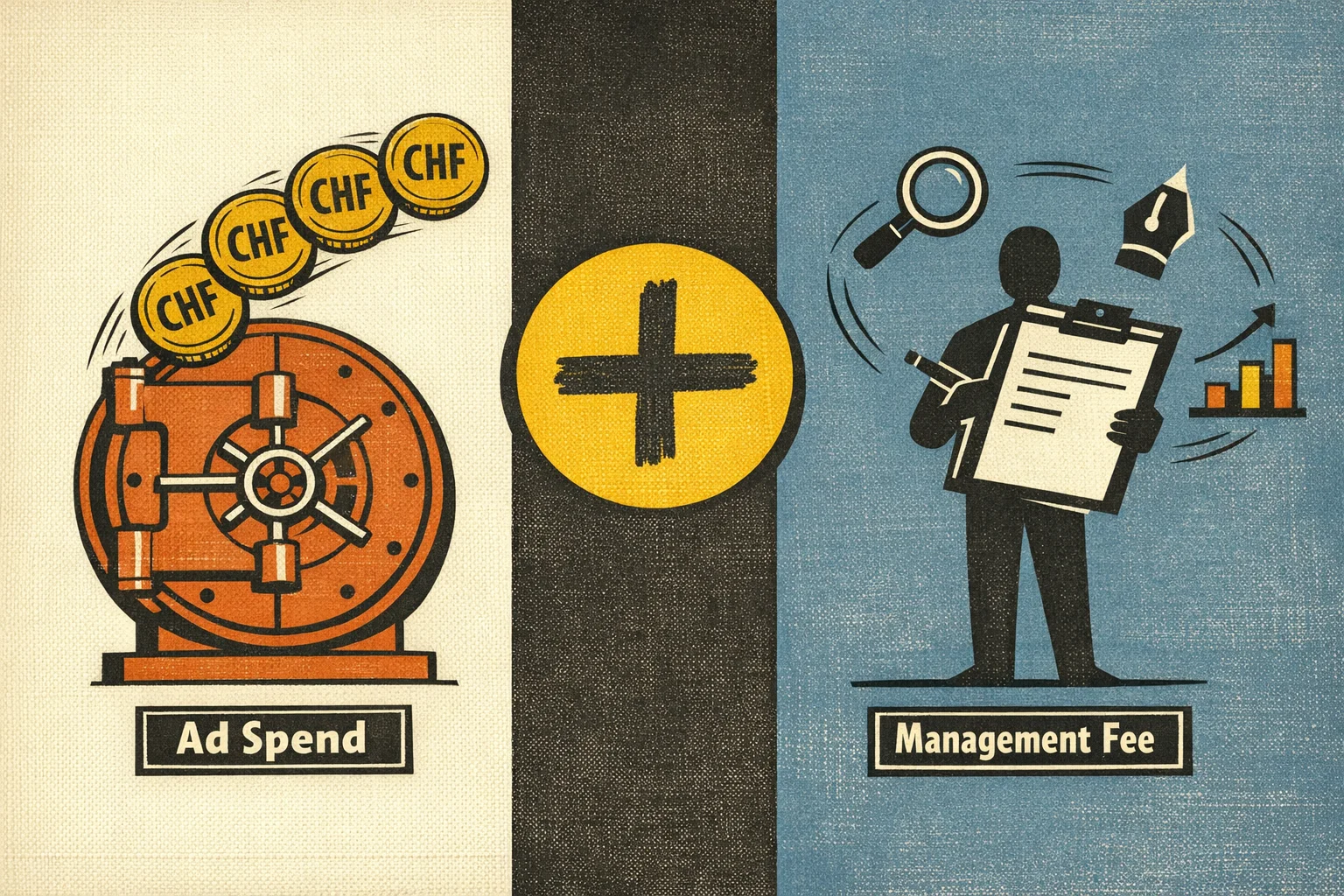
Meta Ads pricing has two completely separate components. Most agencies are not upfront about this — and it's why business owners get surprised by bills or feel like they're not getting what they paid for.
Component 1: Ad spend. This is the money you pay directly to Meta (Facebook/Instagram) for your ads to be shown to people. It never passes through my hands. Meta charges your card directly. A realistic minimum for a Swiss service business is CHF 15–30 per day, which is CHF 450–900 per month. Some clients start at CHF 10/day and scale from there.
Component 2: Management fee. This is what you pay an agency or freelancer to actually run the campaigns — strategy, setup, creative direction, audience targeting, A/B testing, monitoring, and monthly reporting. This is entirely separate from what you spend on the ads themselves.
When someone quotes you "CHF 1,500/month for Meta Ads" — make sure you understand which part that covers. It might be just the management fee, meaning your actual total cost is CHF 1,500 plus whatever you're spending on ads.
What Zurich Agencies Charge — And What I Charge
Let me be direct with the numbers, because very few people in this industry are.
A typical Zurich digital agency charges CHF 600–1,500/month for Meta Ads management, often plus a setup fee of CHF 500–1,000 to get started. You'll be assigned to an account manager who handles multiple clients simultaneously, and your campaigns will often run on templates built for a different industry.
I charge CHF 349/month, with a CHF 190 introductory price for the first month. No setup fee. No lock-in beyond a standard 10-day notice period.
The reason I can charge less isn't because I do less — it's because I have no overhead. No office in Zurich's Kreis 5. No junior account managers. Just me, your campaigns, and a process I've refined to move fast and waste nothing.
Your ad spend stays entirely in your hands. I request partner access to your Meta Business Manager — I never hold your payment method or touch your budget directly. This matters: some agencies bundle ad spend into their invoice and pocket the margin.
The ROI Math That Actually Matters for Service Businesses
Stop thinking about ROI the way e-commerce brands do. You're not Zalando. You don't have a "return on ad spend" of 4x on a CHF 35 product.
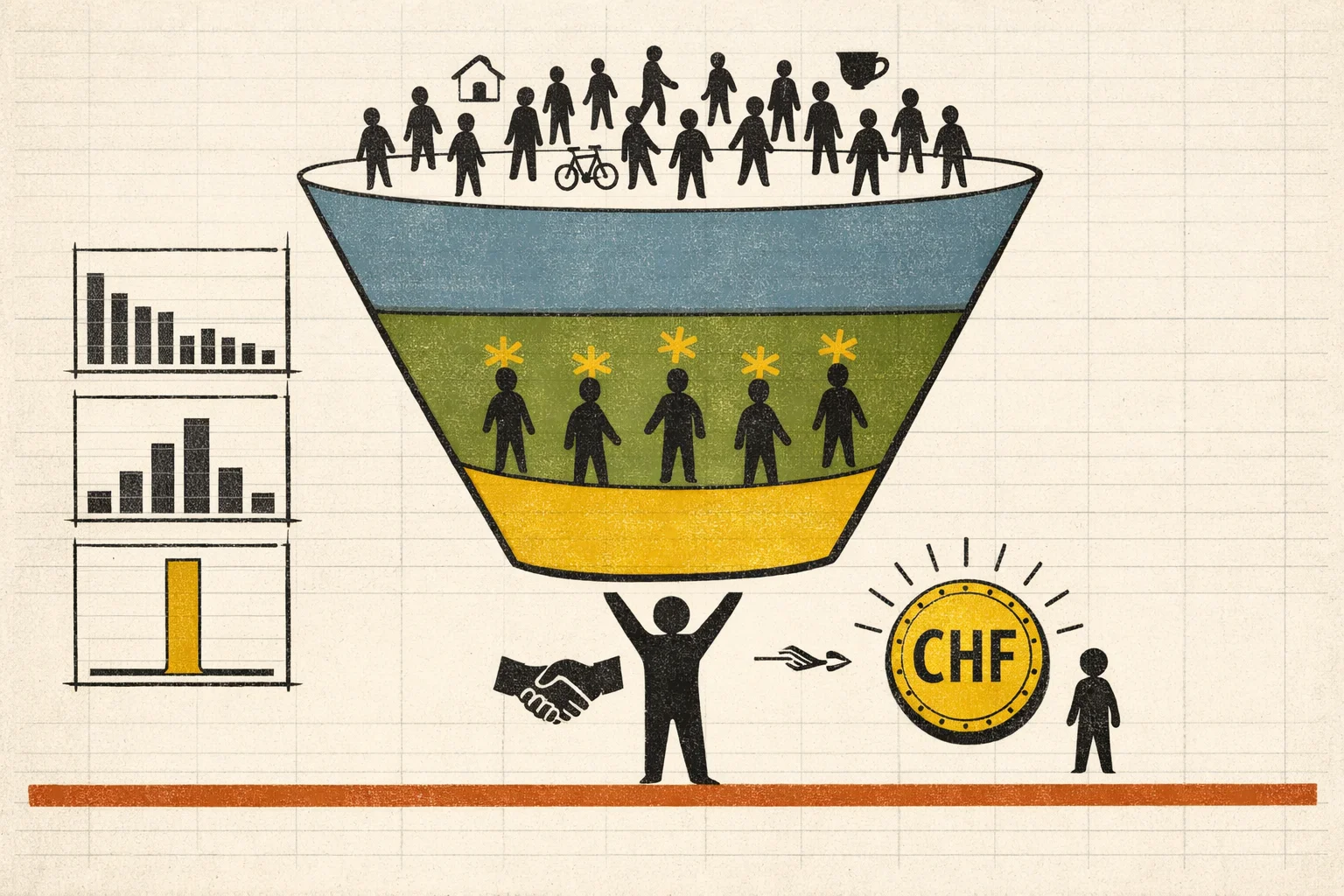
For service businesses, the math looks like this: what is one new client worth to you? Not just the first transaction — the lifetime value.
A hair salon with an average booking of CHF 80, where clients come 8 times a year, is worth CHF 640 per year per client. A management consultant closing a CHF 5,000 mandate only needs to close one every few months to make ads extremely profitable.
Let's run a concrete example. Say you're a financial advisor in Zurich. Average client value over two years: CHF 4,000. Your close rate from a qualified lead: 30%. That means you need about 3–4 good leads to close one client worth CHF 4,000.
If your cost per lead from Meta Ads is CHF 25 — which is realistic for professional services in Switzerland — you're spending roughly CHF 75–100 to acquire a CHF 4,000 client. That's a 40x return.
Month 1 is data. Month 2 is optimisation. Month 3 is growth. The businesses that quit in month 1 never find out what month 3 looks like.
The important caveat: these numbers don't arrive in week one. They build over 90 days.
My 7-Day Process: First Meeting to Campaign Live
This is the part I get asked about most. What actually happens? What do I need from you? When will ads be running? Here's every step.
Day 0 — The First Meeting (30 Minutes)
This is not a sales call. I'm not going to spend 25 minutes showing you slides about why Meta Ads are great and spend 5 minutes asking what you actually need.
I ask you four things: What's your goal? Who is your ideal customer? What's your monthly ad budget? And what does a good result look like to you in 90 days? If you don't know what a customer is worth to you — we figure it out together, right there. That number is the foundation of everything else.
I'll also be honest if Meta Ads aren't the right fit. If you're a B2B company selling software to enterprise clients, LinkedIn will serve you better. I'd rather tell you that in the first call than take your money for three months.
Days 1–3 — Setup (The Part That Determines Everything)
Most businesses that fail with Meta Ads skip this phase or rush it.
First: Meta Business Suite — the control centre for all your Facebook and Instagram advertising. If you don't have one, I set it up on your behalf, linked to your business page and Instagram account.
Second: the Meta Pixel. This small piece of code goes on your website and tells Meta who visited, what they did, and which visitors became leads or customers. Without it, Meta's algorithm is flying blind. With it, it can find more people who look like your best customers. It's the single most important technical piece in your entire ad setup — and I install it, test it, and verify every key event is firing correctly before we spend a single franc.
Third: a kick-off questionnaire. Seven targeted questions covering your product, ideal customer, competitors, and visual preferences. Takes you 10 minutes. Saves us weeks of guesswork.
Days 3–5 — Strategy and Creative (Where Most Agencies Cut Corners)
I open the Meta Ad Library — a free, public database of every ad currently running on Facebook and Instagram — and study your top 3 competitors. I'm specifically looking for ads running for more than 30 days, because those are the ones that are working.
Then I define 3 ad angles for your campaign. An angle isn't a visual style — it's a reason someone should care:
- Angle 1 (Problem): "Still struggling with X? Here's why it keeps happening."
- Angle 2 (Social proof): "Swiss businesses trust us with Y because Z."
- Angle 3 (Curiosity): "The one mistake most [target audience] make with [problem]."
For each angle, I write 2 hooks — the first line of your ad, the thing that stops the scroll. Then the full ad copy: body text, headline, and call to action. And I send you a creative brief: exactly what photos or videos I need from you, in what format, with what visual direction.
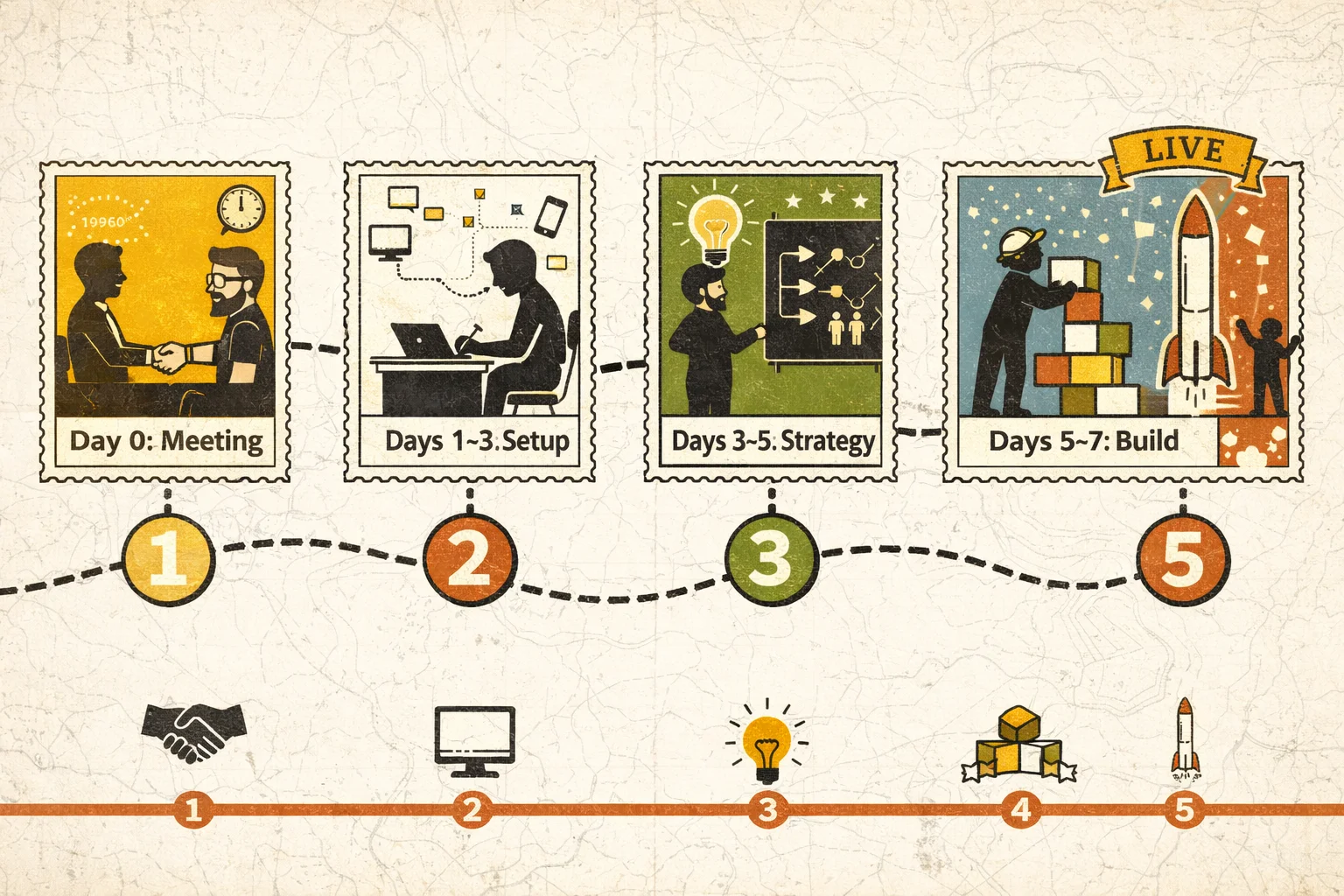
Days 5–7 — Build and Launch
The campaign goes into Meta Ads Manager following a strict structure with naming conventions, ad set segmentation, and A/B testing built in from day one. UTM tracking parameters go onto every link so we can see exactly which ad drove which lead inside your analytics.
I run a pre-launch checklist: no policy violations, Pixel verified, lead form tested, mobile preview confirmed — 90% of Meta traffic is mobile. Then we go live. And for the first 7 days, we don't touch anything. Every significant edit resets the learning phase, and that's a mistake I've seen kill more campaigns than bad creative ever did.
Months 1, 2, and 3: What to Actually Expect
Month 1 — The Learning Phase. Meta's algorithm needs approximately 50 optimisation events to exit the learning phase and start delivering ads efficiently. Results will feel inconsistent. Some days 3 leads, some days zero. This is normal. Don't panic, don't edit everything, don't call me asking to change the targeting after day 4.
Month 2 — The First Conclusions. Now we have data. Which angle generates leads? Which audience responds? Which hook gets clicks? The bottom 30% gets paused. The top performer gets more budget. New creative variations get introduced to fight fatigue. Your cost per lead starts to drop.
Month 3 — Predictable Growth. By month 3, you have a system. A consistent lead flow at a cost you understand, from an audience proven to convert. Now we optimise deeper: new formats, lookalike audiences built from your existing customers, retargeting campaigns for people who visited your website but didn't contact you.
The businesses that call me frustrated at month 6 are almost never frustrated because Meta Ads stopped working. They're frustrated because they stopped them at month 1.
Good Management vs. Bad: How to Tell the Difference
You should be able to spot the difference in week one.
Bad management: boosted posts, broad "Switzerland, 18–65, all interests" targeting, no Pixel installed, no A/B testing, no monthly report, no strategy beyond "let's run some ads and see what happens."
Good management: Pixel tracking verified before launch, custom audiences built, named campaign structure, at least 2 ad angles tested simultaneously, written monthly report with real metrics — CPM, CTR, cost per lead — and proactive creative refresh every 4–6 weeks when frequency climbs above 3.
Red flags when talking to an agency: they promise results in week 1, they don't mention the learning phase, they bundle your ad spend into their invoice, they can't explain what the Pixel does.
Green flags: they ask about your business goals before talking about ad formats, they tell you the first month is about data collection and not miracles, they're honest about what they'll do if results aren't there by month 3.
The Honest Bottom Line
Meta Ads work. But they work like a garden, not a vending machine. You plant seeds, water them, wait for the algorithm to learn, and then — with patience and the right adjustments — you get a system that generates leads predictably every month.
For a Swiss service business, the math is often very favourable. A CHF 349 management fee plus CHF 500/month in ad spend totals CHF 849/month. If your average client is worth CHF 1,500 and you close even one per month from your campaigns, you're profitable by month 2.
The question isn't "do Meta Ads work?" The question is: am I willing to give them 90 days and run them properly?
Key Takeaways
- Two separate costs: Ad spend goes to Meta; management fee goes to your agency. Never let anyone bundle them without explaining both.
- Think lifetime value, not ROAS: One CHF 4,000 client acquired for CHF 100 in ad spend is a 40x return. Calculate yours before you start.
- Month 1 is data, not results: The algorithm needs time to learn. Businesses that quit in month 1 never see month 3.
- Setup determines everything: The Pixel, campaign structure, and ad angles in the first 7 days either accelerate or doom the next 90.
- Spot red flags early: No Pixel, boosted posts, no monthly report — these are signs of bad management, not bad advertising.

Paulo Lopes
Founder & CTO
Founder of Lopes2Tech, specializing in AI-powered development workflows and high-performance web applications for Swiss businesses.
Ready to start?
Ready to grow your Swiss business?
We build fast, intelligent websites and systems that generate leads while you sleep. Let's talk about your next project.
Book a free consultation
